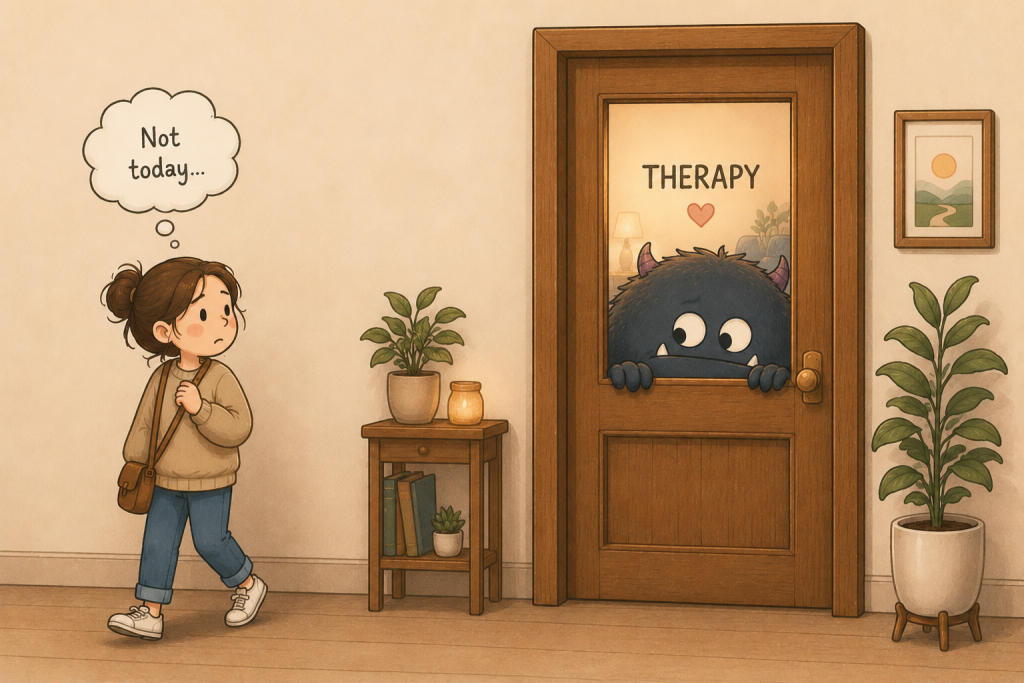
There’s always a version of therapy people imagine before they ever walk through the door.
Maybe it’s a sterile office and a stern therapist. Maybe it’s a couch and questions about your
mom. Most people assume they’ll be asked to immediately share their most guarded fears,
traumas, and wounds and dive in all at once.
That’s not how it works.
Therapy is much more relational than people expect. It’s a conversation—really, many
conversations—but with intention. You talk about what’s been weighing on you, and instead of
getting quick answers, you get space to understand it. Sometimes that means slowing down
enough to notice patterns you’ve been living out for years without realizing it.
You don’t have to share everything at once. Most people start with what feels manageable. Over
time, as trust builds, the deeper things tend to surface naturally. A therapist isn’t there to judge or
produce “fast results.” They’re there to help you make sense of your experience and figure out
what actually works for you.
Some sessions feel clear. Others feel messy. Both matter.
So why do people avoid therapy?
For some, it’s the fear of being exposed. If you’ve spent years holding things together, saying
“I’m not okay” out loud can feel like losing control. For others, it’s skepticism—wondering if
talking really helps, or assuming their problems aren’t “serious enough.”
There’s also the discomfort factor. Therapy often asks you to look at things you’d rather avoid—
painful memories, difficult relationships, or habits that aren’t working. Even when you want
change, it’s natural to resist what might get you there.
For many, faith plays a role in that hesitation. There’s often a quiet belief that if your faith is
“strong enough,” you shouldn’t need therapy—that you should be able to pray your way through
it. But therapy doesn’t replace faith or compete with it. It creates space to explore how your
beliefs and your lived experience intersect—where questions, struggles, and doubts can be faced
honestly. For many, that kind of integration doesn’t weaken faith; it deepens it.
And then there are the quieter reasons. Not wanting to burden anyone. Feeling like you should
handle it on your own. Wondering what it says about you to need help.
But therapy isn’t about weakness or failure. It’s about paying attention to your thoughts, your
patterns, and your relationships in a way most people don’t make time for.
At its core, therapy is a place to be honest without having to perform. No masking. No
pretending. No pressure to have it all figured out.
Just the work of understanding yourself more clearly—and deciding what you want to do with
that.